






Summary
Simulated Process vs Full-Colour (CMYK) Screen Printing
When printing photographic or detailed designs on garments, you can choose between Full-Colour Process (CMYK) or Spot Colour (Simulated Process).
Full-Colour (CMYK) Printing
- Uses four translucent inks: cyan, magenta, yellow, and black.
- Works best on white shirts, as shirt colour affects the print.
- Ideal for photo-realistic images with fewer screens.
- Can look muted on coloured garments, even with a white base.
Spot Colour (Simulated Process)
- Uses opaque inks, often 8–12 colours, blended to recreate the image.
- Works on light or dark garments.
- Produces vibrant, accurate colours and high contrast.
- Can incorporate the shirt’s colour into the design.
Which to Choose?
- Go CMYK for photo-style prints on white garments when you want fewer screens.
- Go Spot Colour for bold, high-contrast designs, especially on dark shirts.
Spot Colour vs Full Colour Printing in Screen Printing
There are two main ways to screen print a photographic image. There’s the Simulation Process, and then there’s the Full-Colour (CMYK) Process.
When it comes to screen printing photographic images or detailed artwork onto garments, there are two main methods: Spot Colour (Simulated Process) and Full Colour (CMYK) Process. Both are printed using tiny dots lined up in exact registration to simulate the image. These dots are called half-tone dots.
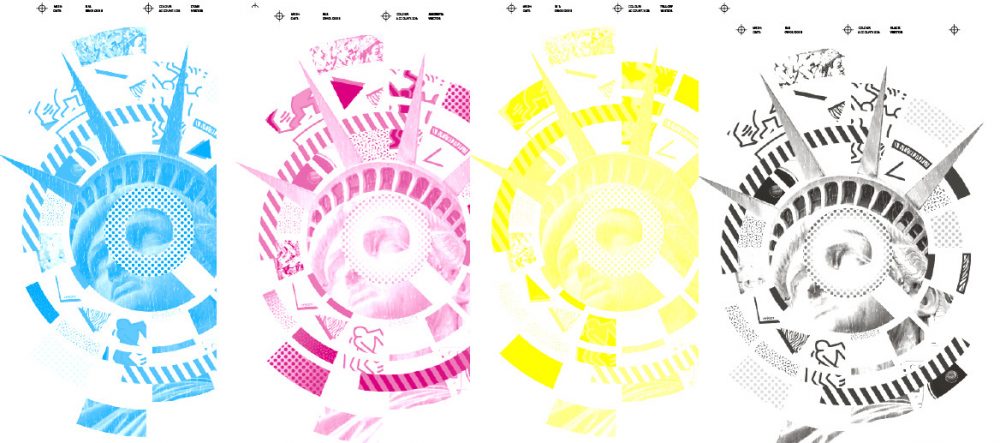
The basic idea behind screen printing involves the use of screen stencils. These screen stencils can either be made from spot colour or the full-colour process, and each colour is represented by an individual screen. Process colour printing is always four colours – Cyan, Magenta, Yellow and Black, while simulated process or spot colour printing can be many more colours.
What is Full Colour Printing (CMYK Process)?
Full-colour process or CMYK inks (cyan, magenta, yellow, and black) are used as the industry standard for paper printing, but not often for printing t-shirts. The reason is, it only works on white t-shirts. The inks for CMYK printing are translucent, and the light passes through each to the white shirt on the bottom and then reflects back to the eye. If the shirt is coloured, it changes what you see. Sometimes it can work to print white ink underneath, but the nature of screen print causes the CMYK print to look muted or washed out when printed on white ink. So generally, CMYK printing is not a common process for printing on clothing.
Which One Should You Use?
Use CMYK if you’re printing photo-realistic images on white garments and want to keep the number of screens to a minimum.
What is Spot Colour Printing (Simulated Process)?
The simulation process involves using opaque inks in solid colours and mashing them together on the press to create different colours and blends. When printing this way it works well with a white under layer, plus it is possible to use the colour of shirt as part of the formula.
Complex computer software can make these colour separations taking into account the shirt colour and give the printer a good start with how it should be printed.
Once the software finishes it’s part, it is up to the printer to adjust the separated colours in order to make a good simulation of the image. Simulated process often tends to be a lot of colours to create a good image. Eight, ten or even twelve colours is normal, unlike full-colour CMYK printing.
The spot colour printing method ensures a sharp, accurate print. Because the inks are opaque, this method works well on both light and dark garments.
Which One Should You Use?
Use Spot Colour if your image has a lot of contrast, you’re printing on dark shirts, or you want vibrant, bold colours.
Key Differences between Spot Colour and Full Colour Printing
| Feature | Spot Colour (Simulated Process) | Full Colour (CMYK Process) |
|---|---|---|
| Number of Screens | Varies (often 8–12) | Always 4 (Cyan, Magenta, Yellow, Black) |
| Ink Type | Opaque | Translucent |
| Best for Shirt Colours | Light or Dark | White only |
| Colour Accuracy | Very High (especially on darks) | Can be limited on non-white shirts |
| Complexity | Requires image separation and adjustment | Simpler prep but limited application |
| Use of Shirt Colour | Yes | No |
Types of Screen Printing and Their Applications
Plastisol Ink Printing provides durable, sit on top of the fabric providing a more vivid colour, results in a less soft hand, and requires curing at a temperature of 270 to 320 degrees F. Another advantage is that they don’t dry in the screen, are very opaque on darker coloured garments, and adhere to most textiles.
Discharge Ink Printing is growing in popularity. Discharge inks remove the shirt’s dye (somewhat like bleach) and replace the color, instead of printing colour on top of the shirt. This solution makes use of water-based inks and results in a softer feel and the look has a vintage style that customers love.
Vintage and distressed printing give you a similar effect as distressed jeans. It’s a real classic. With t-shirts, it’s pretty cool and has that by-gone era look or an authentic feel. People pay extra for this effect. The less amount of ink laid down on the garment provides a softer feel. Breaks in the ink layer make for a more flexible print, and the fabric itself is more breathable.
A Couple of Application Examples
Custom t-shirts are GetBold’s specialty. We see great results from our work on a regular basis. Whether your goal is to represent your business, your team, your school, or just want something fun, GetBold will help you get there. We have some great ideas to inspire you right here in our showroom. And we know just the right printing technique that is most appropriate for your design.
Custom jackets can make a real statement. And it is a great way to ensure that your message is not covered over by employees wearing layers of cloths. Whether you need custom company identity to promote your brand or a team-look in colder weather, GetBold has a wide variety to choose from.
GetBold When It Comes to Custom Designed Apparel
At GetBold, we are definitely in the people business. Our expert apparel printers maintain a sense of pride in our work. We know that you, our customer, will benefit not only from our expertise but also from our attitudes.
FAQ – Spot Colour vs. Full Colour Screen Printing
What is the Full Colour (CMYK) printing process?
Full Colour printing uses translucent CMYK inks (cyan, magenta, yellow, and black) to create photographic images. It works best on white garments because the fabric provides the reflective base. On coloured apparel, results can appear dull or washed out.
How does Spot Colour (Simulated Process) differ from Full Colour?
Spot Colour employs opaque inks and multiple screens—typically 8 to 12—to simulate a full-colour image. It blends inks right on the press and works well on both light and dark fabrics, achieving vibrant prints with high contrast.
What are the advantages of each method?
Full Colour uses only four screens and simplifies setup, making it quicker and potentially cheaper. Spot Colour, though requiring more screens, offers superior colour accuracy, bold visuals, and compatibility with dark garments.
Which should I use for printing on dark garments?
Spot Colour is ideal for dark fabrics due to its use of opaque ink and ability to incorporate the garment colour into the design for a more visually striking effect.
Are there alternative printing techniques besides CMYK and Spot Colour?
Yes. Plastisol inks sit on the fabric, delivering bold colours and durability. Discharge printing, in contrast, removes the garment dye and replaces it with pigment, resulting in a soft, vintage-inspired look ideal for a softer hand.