
The Enduring Legacy of Screen Printing: From Ancient Fabrics to Modern T-Shirts
Blog post by GetBold
Published at Wed Jun 19 2024
Published at Wed Jun 19 2024
Introduction
Screen printing boasts a remarkable history, intricately woven into the fabric of art and design. Its journey began centuries ago, and it continues to be a popular choice for creating bold and vibrant graphics on a wide range of surfaces.
Ancient Origins in Asia
Evidence suggests screen printing's roots trace back to China during the Song Dynasty (960-1279 AD). Early artisans used intricate stencils and finely woven mesh to transfer designs onto fabrics. This technique soon spread to neighbouring Asian countries, where it evolved further.
Japanese Innovation
Japan adopted screen printing with a unique approach. Their techniques employed simple stencils cut from paper and mesh crafted from human hair! Ink was then forced through the mesh onto fabrics using stiff brushes, creating distinctive imagery.
The Rise of Silk and European Adoption
The 19th century marked a turning point when silk mesh became readily available from Asia. This newfound accessibility fueled the popularity of screen printing in Europe, making it a profitable and practical method.
20th Century Advancements: Squeegees and Photo Stencils
The early 1900s witnessed two significant advancements. The introduction of squeegees revolutionized the process by efficiently pulling ink through the screen mesh. Additionally, Roy Beck, Charles Peter, and Edward Owens are credited with a game-changer: utilizing photography to create stencils, forever transforming the commercial screen printing industry.
Beyond Fabrics: Versatility Takes Center Stage
Screen printing's versatility shone as the ability to print on diverse materials like paper, metal, wood, glass, and even DVDs came to light. Of course, its application on T-shirts remained a cornerstone.
Serigraphy: Art Takes the Stage
The term "serigraphy" was coined in 1938 by a group of artists who aimed to distinguish their artistic use of screen printing from its industrial counterpart. This term, derived from Latin and Greek words meaning "silk" and "to draw," respectively, highlighted the artistic merit of the technique.
Pop Art Revolution
The 1960s witnessed screen printing's rise as a prominent art form. Pop Art legends like Andy Warhol, Robert Rauschenberg, and Peter Blake embraced this technique to create iconic works.
The T-Shirt Boom and Beyond
During the same era, American entrepreneur Michael Vasilantone developed a rotatable multi-colour garment screen-printing machine. This innovation sparked a boom in printed T-shirts, a trend that continues to this day, accounting for over half of all screen printing activity in the US.
A Legacy of Self-Expression
A quote from The Printers' National Environmental Assistance Center aptly captures the essence of screen printing: "It has been used frequently in underground settings and subcultures... the non-professional look of such DIY culture screen-prints has become a significant cultural aesthetic." Screen printing empowers artistic expression and fosters a unique aesthetic that transcends boundaries.
GetBold: Carrying the Torch
GetBold, a Vancouver-based custom-designed screen printing company, proudly carries this torch of self-expression. We provide expert guidance throughout the process, transforming your artwork into stunning custom apparel. Let GetBold help you create your own piece of screen printing history.
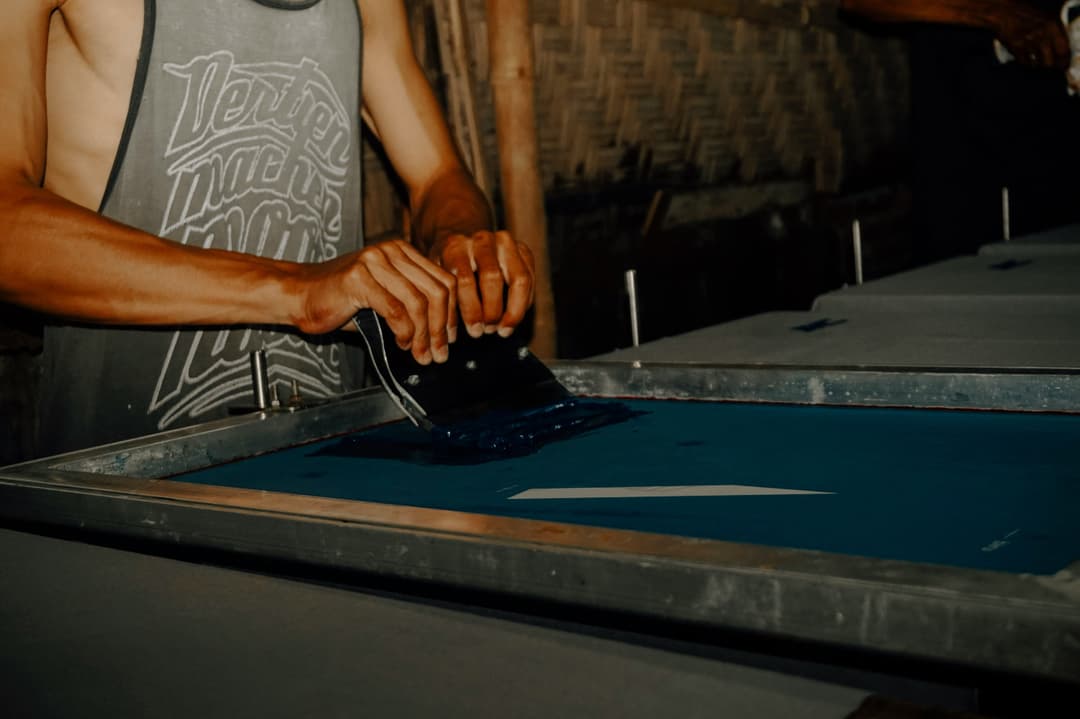
Photo by Angga Kurniawan on Unsplash